
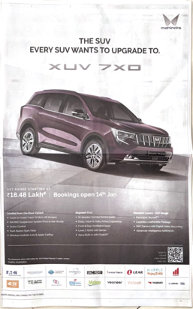
Dear readers, today we bring to your attention a 2026 advertisement by Mahindra Auto, one of India’s largest passenger and commercial vehicle manufacturers.
The new XUV 7XO ad’s title reads: “The SUV every SUV wants to upgrade to”.
It sounds good – unquestionably.
Let us look at it through OPPP! deeper lens.
Firstly, we can see that the company presents as presupposed the fact that every SUV wants to upgrade to something different. The presupposition is activated by the definite description introduced by the article the, which includes the relative clause. Another presupposition is activated by the semantics of the verb upgrade, which presents as an objective fact that this SUV is superior to all others; although this is not necessarily true.
Furthermore, the text employs a metaphorical expression (a case of implicature). Indeed, every reader knows that it is only by metaphor that a car wants to upgrade to something (or to do anything altogether). So, what is the underlying meaning of this expression? Probably, that Mahindra XUV 7XO is the SUV that every SUV driver wants to upgrade to – and SUV drivers or people passionate about SUVs are the main target of this text. A typical move of advertising texts: convincing people that they want something, and that that something is the promoted product.
Yet, when reading the ad, to what extent do we pay attention to this layer of meaning?
If made explicit, the text would say: “Every SUV driver wants the Mahindra 7XO, because this is superior to whatever they have”.
Would this explicit version still sound good and appealing?
Maybe we should ask our cars…